Anthropology Professor Receives Independent Scholarship, Research and Creativity Award
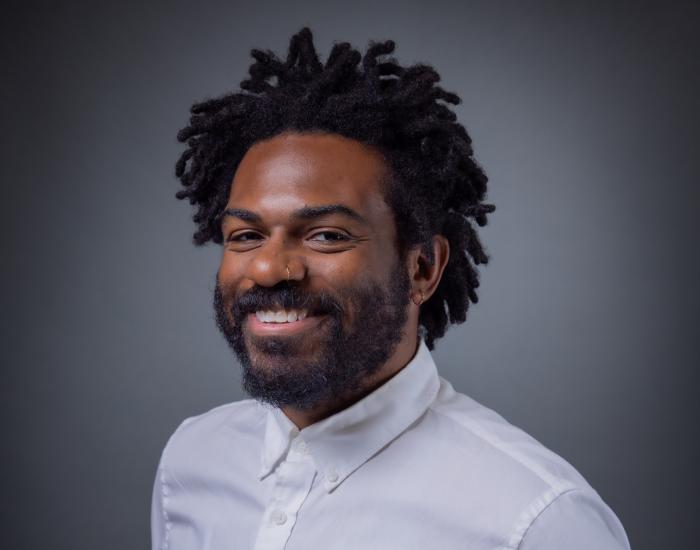
Along with 10 other University of Maryland faculty members, Department of Anthropology Assistant Professor Ampson Hagan has received an Independent Scholarship, Research and Creativity Award (ISRCA) award from the Office of the Provost and the Division of Research.
ISRCA awards provide up to $10,000 in support to faculty who are engaging in scholarly and creative work. In Hagan’s case, that work involves writing a book about the observations he made, and conversations he had, at humanitarian camps in Niger in 2017 and 2019-2020.
“This is only my fourth semester at Maryland, so to have folks at the university look favorably upon my application is a great feeling,” Hagan said. “I feel like this project has legs, and I’m glad that Maryland sees value in it too.”
Hagan traveled to Niger to begin to explore the idea of “rescue” while in the third year of his Ph.D. program at the University of North Carolina, Chapel Hill. He thought it would be a good place to explore the subject, given that migrants from all parts of Africa have been passing through the region in the hopes of reaching North Africa and Europe for decades.
“While I was at one of these large humanitarian camps, I started to think about the impossibility of ‘rescue’ for these persons. These individuals left their homelands because their homelands couldn’t give them what they needed in the first place, but to these humanitarian organizations, their ultimate form of ‘rescue,’ as they define it, is repatriation,” Hagan explained.
Hagan says that the book—which he plans to call “Impossibility of Black Rescue: Humanitarianism and Unauthorized African Migrants in Niger”—will walk readers through different scenarios and encounters that made him think twice about what “rescue” means to the many different kinds of people that he met during the roughly 13 months he spent in Niger. Those people include police officers, who were targeting migrants for repatriation on the grounds that the migrants were depleting Nigerian resources and increasing crime in the area.
“Generally, those who are invested in humanitarianism recognize that people are suffering or in danger and want to do something to help. But through the work of rescuing people, we have organizations who are hiring and training people on how to do this, and it becomes a really complicated business,” Hagan said. “What I hope people take away from the book is that even though we like the idea of saving people, sometimes the act of rescuing people can do as much harm as good. I want people to have a discussion about that; you’re not a bad guy if you question the merits of humanitarianism.”
Published on Tue, Apr 7, 2026 - 11:43AM