


GVPT Alumnus the Author of Maryland’s First Book on Post-Conviction Law
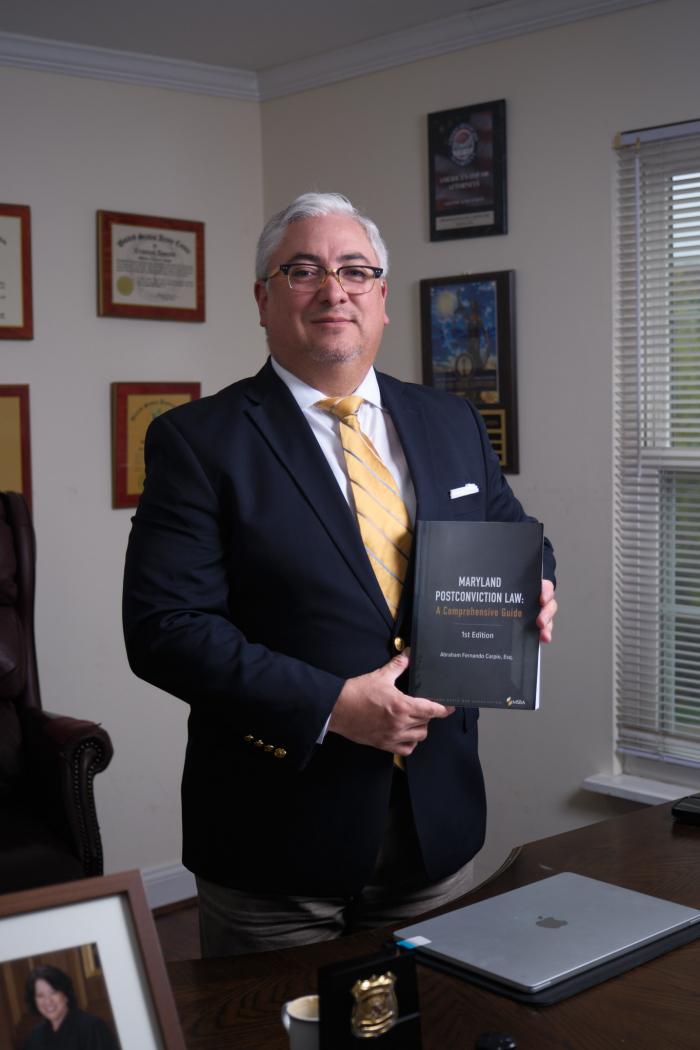
Abraham Fernando Carpio almost didn’t become a criminal defense attorney, even though his family expected it of him, given that his father, grandfather, and great-grandfather were all criminal defense attorneys too.
Instead, as a senior political science and philosophy double major at the University of Maryland, Carpio was considering pursuing a Ph.D. in philosophy and becoming a professor—until he took former UMD professor Judith Lichtenberg’s philosophy of law class.
“That class is what tipped me over the edge to go to law school,” Carpio, a 1994 graduate of the departments of government and politics and philosophy, recalled. “I got into most Washington, D.C. law schools, but the University of Maryland Francis King Carey School of Law was the most suitable choice for me because it carries the same history and tradition I had as a Terp—a tradition I wanted to carry with me throughout my law career—and the fact that the campus is in Baltimore gives students access to the circuit courts, the federal courts, state government agencies and lots of training and litigation opportunities.”
The Maryland law community has benefited from Carpio’s decision to become a fourth-generation criminal defense attorney: He wrote the state’s first book on post-conviction law, “Maryland Postconviction Law: A Comprehensive Guide,” in 2024. He is currently in the process of publishing a second edition of the book, which will include additional chapters, a more robust section on habeas corpus, and templates for judges to follow.
“Post-conviction law is a very niche area of law; very few practitioners do it,” explained Carpio, one such practitioner. “From filing a motion for a new trial all the way to a pardon, it is a much-needed book that was drafted not for profit or gain, but to assist innocent defendants, practitioners of law crimes, prosecutors and attorneys.”
Carpio is also working on a new book concerning the special immigrant juvenile status of children.
“This is another very niche area of immigration law, but it enables children who are abused, neglected or abandoned to obtain legal status in the United States if they are abandoned or neglected by one or more parents. This will cover all 50 states, and include a comparison of law to case law across the country,” Carpio said.
Issues impacting immigrants to the United States is personal to Carpio, who emigrated from Peru with his father when he was 16 years old.
“When my father and I moved to Maryland, we came here for the prospect of finding a better future for ourselves and our family—my little sister stayed back home with my Mom,” Carpio said. “It was a lot at the beginning. I had to learn the language, take an SAT in English, and get admitted to UMD with good parameters. It was a lot of work but it was worth it; going to UMD was probably the best and most important decision of my life.”
Carpio became a United States citizen during law school, and eventually went on to serve in the U.S. Army.
“I wanted to say thank you and give back, so I joined the Army as an officer and then became a Judge Advocate General (JAG) officer, a lawyer for the military. That was one of the best career moves I ever made, because the JAG Corp is the oldest law firm founded in 1774, and the training you get, the camaraderie from your colleagues, and the number of cases you have is quite impressive. I don’t think you can get better training from any other law firm or institution,” said Carpio.
Carpio stayed with the JAG Corps for six years, then worked in the Maryland Attorney General’s office on criminal appeals for another six years before opening his own private practice, Carpio Law Firm, LLC.
At his law firm, and in the pursuit of his additional law endeavors, Carpio draws on skills he learned and honed during his time at UMD.
“Self discipline is very important, to be able to sit down and do the work you need to do to be able to accomplish your goals,” said Carpio, who was president of the Latino Student Association for two years as an undergraduate. “Being on a campus where you have 500-600 students in class with you, you need to have self-discipline so you can surmount those big classes or you’ll lag behind. And in small classes, it's even more important because there’s more competition for grades. I didn’t graduate with a perfect GPA, but I had a high GPA and did pretty well on the LSAT, and I don’t think I would have accomplished any of that if I didn’t learn self discipline and the methods to study and accomplish tasks efficiently. That has carried me through college, law school, and my career.”
While Carpio does see some benefits of the use of artificial intelligence in law—he’s currently working on developing an objection-based AI tool that law schools and law firms can use to help train young lawyers for trial—he encourages students interested in pursuing law careers to have discipline around using artificial intelligence, too.
“Unfortunately, the AI tools we have are so powerful that you could write a perfect essay or a perfect case brief using AI and that will detract from your own thinking. I recommend that AI be used sparingly, because you won't be able to develop the thinking skills and analytical skills that you need,” said Carpio.
He also recommends that students who are considering attending UMD go ahead and apply.
“My experiences being a Terp, in undergrad and law school, have been fantastic. The level of education you get as a Terp is incredible,” said Carpio. “I highly recommend anyone considering going to Maryland to make the effort to apply and join the ranks of our distinguished alumni.”
Photo by Marshall Travis
Published on Thu, Aug 6, 2026 - 10:05AM