

A Peek Inside … Zooarchaeologist Barnet Pavão-Zuckerman’s Office
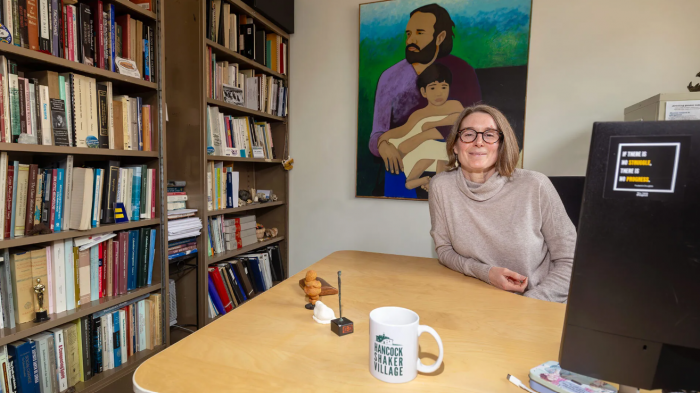
Anthropology Chair’s Space Features Fossilized Mammoth Toe, Grandfather’s WWII Heirloom
A scavenged deer bone from the parking lot of Barnet Pavão-Zuckerman’s undergraduate apartment complex gave her to the courage to speak to a professor about changing her major.
“I needed an excuse to go see him,” said Pavão-Zuckerman, who was curious about anthropology but didn’t want to study human remains. “I walked into his zooarchaeology lab, and it was full of skulls and animal bones. It wasn’t quite like the heavens opened, but it was definitely a moment where I was like, ‘Wow, this is a thing I could study!’”
Today, she’s the chair of the University of Maryland’s Department of Anthropology, researching how animal remains can offer insights into human history. That includes the wide-ranging impact of the cattle economy in colonial Charleston, South Carolina; fish, rabbits and raccoons as supplemental foods in enslaved communities such as James Madison’s Montpelier in Virginia; and the introduction of livestock to Native American communities in Arizona.
While she displays a few real animal skulls and some replica fossils in her office, the real trove is two floors below. In the Woods Hall basement, drawers upon drawers of every type of animal bone, from bird to lizard to mammal, are carefully catalogued for students to study. Some are purchased, while others, like a fox that Pavão-Zuckerman found mostly decomposed in the woods on a hike, were scooped into a bucket, brought in, and treated with a special detergent to clean them for use in class.
She explains why she has a dire wolf skull, how her family got her into archaeology and the origins of the World War II victory flag hanging from her filing cabinet.
Read the rest of Karen Shih's story in Maryland Today
Photo by Stephanie S. Cordle
Published on Fri, Feb 27, 2026 - 9:38AM