


Watch the Sadat Forum: “Business as Usual or the End of America’s Middle East”
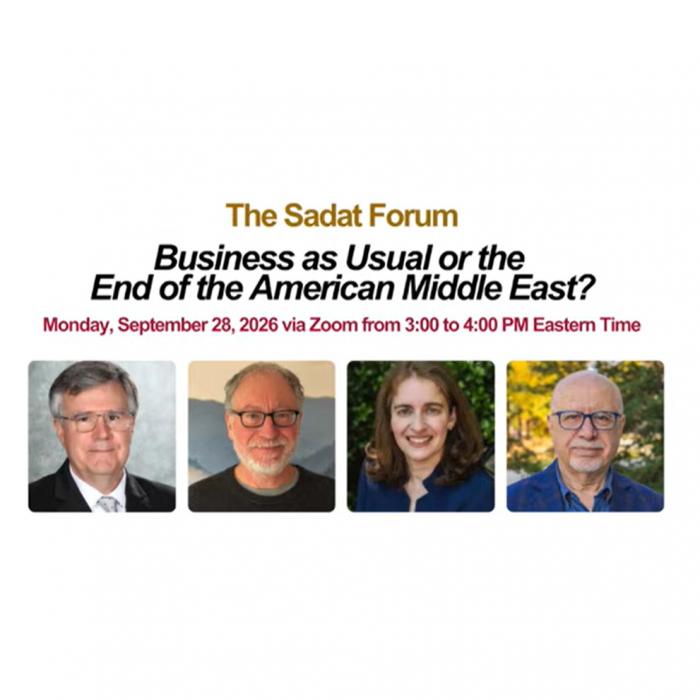
On Sept. 28, Anwar Sadat Professor for Peace and Development Shibley Telhami moderated a virtual discussion between three prominent international relations scholars: Gregory Gause of Texas A&M University, Marc Lynch of George Washington University, and Elizabeth Saunders of Columbia University. The conversation centered on "Business as Usual or the End of the American Middle East?"
BSOS Dean Susan Rivera provided opening remarks.
Gregory Gause argued that, while there have been important and impactful consequences of the Iran war and the events of the last three years—including strengthening an Iranian regime that had been weakened prior to the war—there has not been deeper systemic change in the region. “The basic conflict dyads in the region remain as they were: Israel versus Iran, the United States versus Iran, Israel versus Iranian allies and proxies… The profound problem of Palestinian self-determination… that's not solved by this war… And you have an Israeli government that, even if it changes with the election later in October, I don't think would be willing to make the kind of compromises necessary to have a real solution to the issue of Palestinian self-determination.”
Gause also argued that he doesn’t see the moment as ushering in “the end of the American role in the Middle East. The last three presidents all campaigned on the idea of pivoting away from the Middle East, and none of them has been able to do it. And I think that this war has just once again dramatized the importance of the oil patch in the global economy. And thus, I don't see this as the end of America's Middle East unless America chooses to leave, which it could do, but I doubt it will. Certainly not in this administration, and I kind of doubt it will in the next.” And while Arab states may be frustrated by the United States’ conduct, they have no immediate alternative to continuing their reliance on Washington.
Marc Lynch’s central disagreement was with the assumption of continued American hegemony in the Middle East after the Iran war. “America's role in the Middle East was premised on the promise of security to its Arab partners and to Israel—that our bases and our air defenses and simply the fact of our commitment would be enough to protect them from attack. And that is clearly not true anymore. And what's more, our reckless behavior, combined with our granting kind of basically carte blanche to Israel to also act with impunity across the region—in Lebanon and Syria, even in Doha, of all places—has basically fundamentally shaken the ability of regional leaderships to believe that the United States can or will live up to its end of the security bargain, either external security or internal security.”
“American primacy is fading. It hasn't been replaced yet, but it's fading. And in the Middle East, as people who follow it closely know, the driving force that's happening right now is actually competition between Saudi Arabia and the UAE over regional order, in a way reminiscent of Qatar versus the UAE and Saudi Arabia back in the 2010s after the Arab Spring. And this is more than just the bickering of Gulf princes. I really think what you're seeing right now is that everybody understands that the nature of regional order is about to change in a fundamental way, and they're arguing with guns and interventions and every other form of means at their disposal over what that order is going to be.”
Elizabeth Saunders addressed the role of the Trump presidency on the unfolding events in the region and globally, starting with the decline of constraints on the president. “It is part of the nature of a democracy to have elites politicking around their leader and hashing these things out. And that is an important form of democratic constraint. And I think what's happened between Trump's first term and Trump's second term is that the constraints from elites have essentially fallen away.”
What the Iran war and other foreign policy challenges have revealed is that “the American security umbrella has a bunch of holes in it right now, and it's just not clear how soon we can repair it and whether we can repair it in time to shore up the architecture… I think the unraveling of whatever the liberal international order was—not fully liberal, not fully international, never fully orderly, but whatever it was—began with the invasion of Ukraine. And now America just does not have enough military power, hard power, to do all these things. Something has to give. And it seems that whatever you think of the basic internal regional architecture, bases in the Middle East seem to be the thing that might give.”
The conversation ended with a reminder that the war has not ended, and the outcome remains highly uncertain, with a number of possibilities that could impact the future trajectory of America’s role in the Middle East. Iran’s incentives to develop nuclear weapons have increased by the war even as its ability may have been weakened. Public US threats to “annihilate” Iran, combined with the fact that Israel already possesses nuclear weapons, add to the volatility and uncertainty.
Story courtesy of the Sadat Chair
Published on Wed, Sep 30, 2026 - 1:43PM