



VRC Publishes Paper Concerning Social Media’s Connection to Community Violence
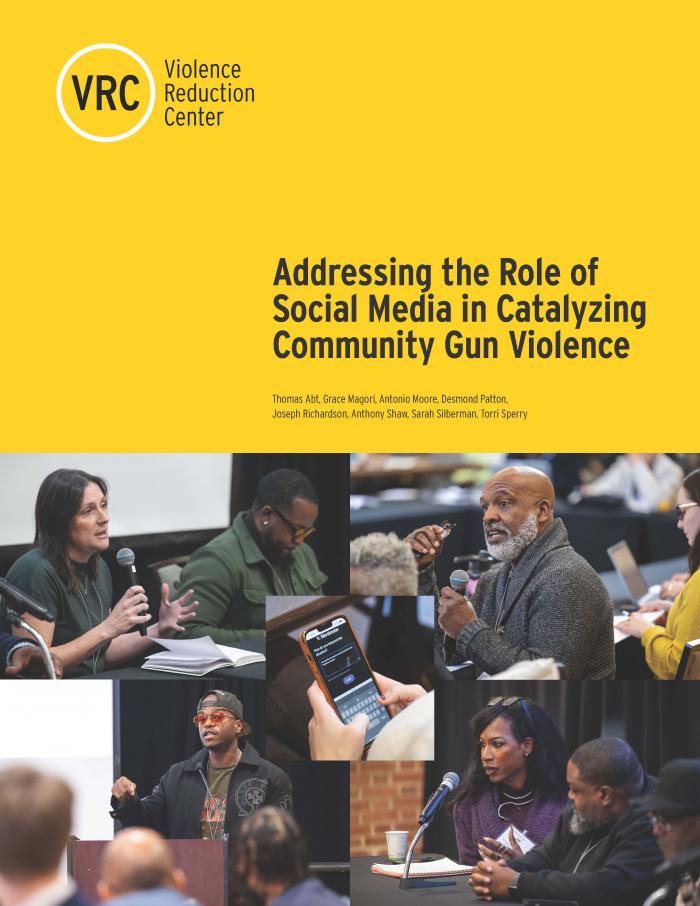
In November 2025, the University of Maryland’s Violence Reduction Center (VRC) hosted a Symposium on Social Media and Community Violence, with support from the Everytown Community Safety Fund and UMD’s PROGRESS initiative.
A new white paper, “Addressing the Role of Social Media in Catalyzing Community Gun Violence,” shares takeaways from the presentations and discussions that were had with the event’s nearly 70 attendees, which included youth speakers from Baltimore, Chicago, Philadelphia, and Toledo, Ohio; as well as representatives from the Baltimore and New York police departments, community violence prevention organizations like Peace for DC and Chicago CRED, academic institutions, and more.
The paper shares summaries and direct commentary from many of the event’s 18 speakers, organized by the kind of perspective they brought to the table: Gen Z and Gen Alpha youths, experts who work for community-based organizations, law enforcement professionals, and academic researchers.
“At the VRC, we believe the best thinking happens when diverse groups come together and challenge one another. That’s what happened at the symposium,” said Thomas Abt, founding director of the VRC and an associate research professor in the Department of Criminology and Criminal Justice. “Ultimately, when you include differing viewpoints from the beginning, it makes any agreements you reach at the end that much more meaningful.”
According to the paper, the youth panelists discussed how competitive social media can be, how that drive to outdo one another often escalates violence, how online intervention can be thwarted due to platform algorithms prioritizing engagement over safety, and the collaborative role they think social media platforms should be mandated play in terms of sharing data.
The need for training and standards on when and how to intervene online, the potential pros and cons of using artificial intelligence to monitor online conflict, and examples of initiatives and professionals that have already successfully intervened on some platforms (“E-responders” and “Peace Guards”), were among the insights shared by the community-based organization experts. Law enforcement experts also shared information about programs they deployed on social media to increase situational awareness, spot violence, aid investigations, and educate the public about what is happening in their communities.
The law enforcement professionals, as well as the researchers in attendance, called for caution in using social media as a tool to support law enforcement, however. They noted that some performative or expressive posts may be just that, instead of a means of communicating or calling for violence. They may also be an important outlet for processing grief and seeking support.
Joseph Richardson, co-director of PROGRESS and a professor in the Department of Anthropology and Department of African American and Africana Studies, was among those attendees who shared their research perspectives. Richardson spoke on the importance of “design justice,” an approach that he uses in his work—with hospital-based violence intervention programs and young survivors of firearm injury—that puts people most affected by violence in the center of the process of creating solutions.
“The symposium was one of the first times that a lot of us had the opportunity to sit down with different stakeholders—from law enforcement and community violence intervention practitioners to members of Gen Z—and directly discuss what is going on with social media and community violence, how we can begin to make sense of it, and how we can move toward solving it,” said Richardson. “I hope that this white paper is widely disseminated so that we can continue the momentum that was started.”
Taking all of the event’s perspectives into consideration, the VRC’s paper recommends that decision makers:
- Invest in local, community-led digital expertise.
- Establish ethical, non-punitive digital early warning systems.
- Develop national best practices and training standards.
- Require meaningful accountability from social media platforms.
- Treat social media as a site of care.
“Our lives online reflect our real-world experiences—our joys, milestones, struggles—and, unfortunately, our conflicts. As practitioners, we have a responsibility to intervene wherever violence occurs,” said VRC Deputy Director Amber Parker. “These recommendations remind us we are most effective when we act together.”
Read “Addressing the Role of Social Media in Catalyzing Community Gun Violence”
Published on Thu, Mar 5, 2026 - 9:35AM